★ MANUFACTURER-APPROVED SOFT WASH · PLAINVIEW, NY
Those black streaks aren’t dirt. They’re a living organism eating the limestone out of your shingles, and a pressure washer will take your roof apart faster than the algae ever will. We kill it at the root using the low-pressure method the shingle manufacturers themselves publish.
The short answer
Roof soft washing is a cleaning method that pairs a low-pressure rinse, roughly the force of a garden hose, with a solution that kills algae, moss and lichen at the root. It removes the organism itself rather than the stain the organism leaves behind.
That distinction is the whole job. High pressure blasts discoloration off the surface while the living colony stays put in the shingle mat, so the streaks return within a season or two. A soft wash kills what is actually growing, and the roof then stays clean for years rather than months.
What you’re actually looking at
The black streaks running down Long Island roofs are Gloeocapsa magma, a cyanobacteria that arrives airborne and settles on any surface staying damp long enough. It is not soot, not mildew, and not weathering. It is alive, and it is feeding.
What it eats is the limestone. Asphalt shingles are made with calcium carbonate filler, and that filler is the food source. As the colony spreads, it loosens the granules bonded to the shingle surface. Those granules are the only thing standing between the asphalt underneath and Long Island’s UV load.
The algae isn’t actually black. Gloeocapsa magma is blue-green. It turns dark because it grows a pigmented outer sheath to shield itself from sunlight. The stain on your roof is the organism’s sunscreen. That is also why streaks always run downward, and why they appear on the north-facing slope first: spores wash down with the rain, and the shaded side stays wet longest.
Why the pattern looks the way it doesTwo things follow. The colony absorbs heat instead of reflecting it, pushing attic temperatures up and making your AC work harder through August. And the granule loss is cumulative and permanent. Cleaning a roof isn’t cosmetic maintenance. It is the cheapest roof repair you will ever not have to make.
Our position
The Asphalt Roofing Manufacturers Association, the trade body for the companies that make your shingles, states it plainly. Their guidance says high-pressure systems are likely to damage asphalt roofing and should not be used to remove algae or for any other purpose.
Read that again. It isn’t a soft-wash company claiming pressure is bad for business. It is the shingle manufacturers saying pressure destroys the product they sell.
Asphalt Roofing Manufacturers Association guidanceThe mechanism is simple. Granules are embedded in the asphalt while it is hot, and they hold with a bond a pressure washer beats easily. Strip them and you expose raw asphalt to UV, which is how a 25-year roof becomes a 12-year roof. The damage doesn’t appear the day of the wash. It appears as a leak four years later, and by then nobody connects the two.
What we do
What to avoid
If a contractor quotes you a roof power wash, that quote is telling you something. Keep calling.
The process
Every roof gets the same five steps, with no shortcuts and nobody walking your shingles unless the pitch genuinely requires it.
We walk the property, note which slopes carry the worst growth, check for lifted or loose shingles, then saturate every plant, bed and lawn edge under the roofline before a drop of solution is mixed.
The solution goes on gently and evenly through a low-pressure applicator. It is never blasted, never scrubbed, and never worked in with a brush or broom.
The solution needs roughly 15 to 20 minutes on the surface to kill the colony through. Budget operators skip this step, which is exactly why their work streaks again by spring.
A gentle rinse carries the dead organism and the solution off the roof and down through the gutters, which get flushed on the way out.
We re-rinse the landscaping, check the beds, and walk the property with you before we pull off the street.
Most single-family roofs on Long Island take two to four hours start to finish. You don’t need to be home, though plenty of people like watching the north slope change color.
Self-diagnosis
Vertical black staining, heaviest at the top and fading downward. That direction alone tells you it is biological, not dirt.
Less sun, slower drying, longer wet time. If one side is noticeably darker than the other, that is your tell.
Sandy grit collecting at the downspout outlets means the shingle surface is already shedding.
Moss and lichen rather than algae. Both hold water against the shingle, and lichen roots into the mat itself.
Growth that maps exactly to your tree canopy. Overhanging limbs keep the surface damp and drop debris that feeds it.
A dark colony absorbs the heat a clean roof reflects. Your AC has been quietly paying for it all summer.
Local conditions
Gloeocapsa magma needs three things: moisture, warmth, and a limestone-filled surface to feed on. Long Island hands it all three, then adds a fourth advantage most of the country doesn’t.
We sit on an island. Humidity comes off the water on both sides and never burns off the way it does inland, so roof surfaces hold moisture for hours longer every morning. Add the mature tree canopy across Nassau and Suffolk, the oaks and maples that make these neighborhoods worth living in, and large sections of roof never get a full day of drying sun.
Then there is the housing stock. Plainview, Syosset, Hicksville, Levittown and the towns around them are dense with post-war and mid-century homes, many carrying roofs installed before algae-resistant shingles were standard. A shingle made without copper granules has no defense at all.
Our honest recommendation: plan on a soft wash every two to three years. Shaded properties and anything within a mile of the water run closer to two. A roof in full sun with no overhanging trees can stretch to four. Anyone quoting you an annual roof cleaning is selling a schedule, not a diagnosis.
Keeping it off
Zinc and copper strips work, and they work on a principle worth understanding before you buy them. Rain dissolves trace metal off the strip, and that ion-carrying water runs down the slope and makes the surface hostile to spores. It is genuinely effective.
Here is what almost nobody tells you. The protection only reaches roughly 10 to 15 feet down the slope from a ridge-mounted strip. On a modest ranch that covers nearly the whole roof. On a two-story colonial with a long run from ridge to gutter, it protects the top third and leaves the bottom two-thirds streaking exactly as before.
Ask this before you buy ridge stripsIf someone sells you ridge strips as a permanent fix on a tall roof, they have either not read the field data or are counting on you not having read it. Newer algae-resistant shingles solve this at the factory instead, blending copper granules across the entire surface, which is why they outperform a strip retrofit by a wide margin. If your roof is due for replacement anyway, that is the moment to fix this permanently.
For everything already on your roof, trimming back overhanging limbs and keeping gutters flowing buys you real time. Neither replaces the wash, but both stretch the interval.
Straight answers
No. Soft washing uses low pressure at roughly garden-hose force, so nothing is scoured off the shingle. It is the method the asphalt roofing manufacturers publish themselves, specifically because high-pressure cleaning strips granules and shortens roof life.
Soft washing does not. Pressure washing very well might. Shingle manufacturers generally condition warranty coverage on the roof being maintained according to published guidance, and that guidance says not to use a power washer. Cleaning it the correct way protects your coverage rather than risking it.
On Long Island, typically two to three years. Shaded roofs and properties near the water sit closer to two. A roof in full sun with no tree cover can reach three to four. Because a soft wash kills the organism instead of rinsing off the stain, it does not reappear the following spring the way a pressure-washed roof does.
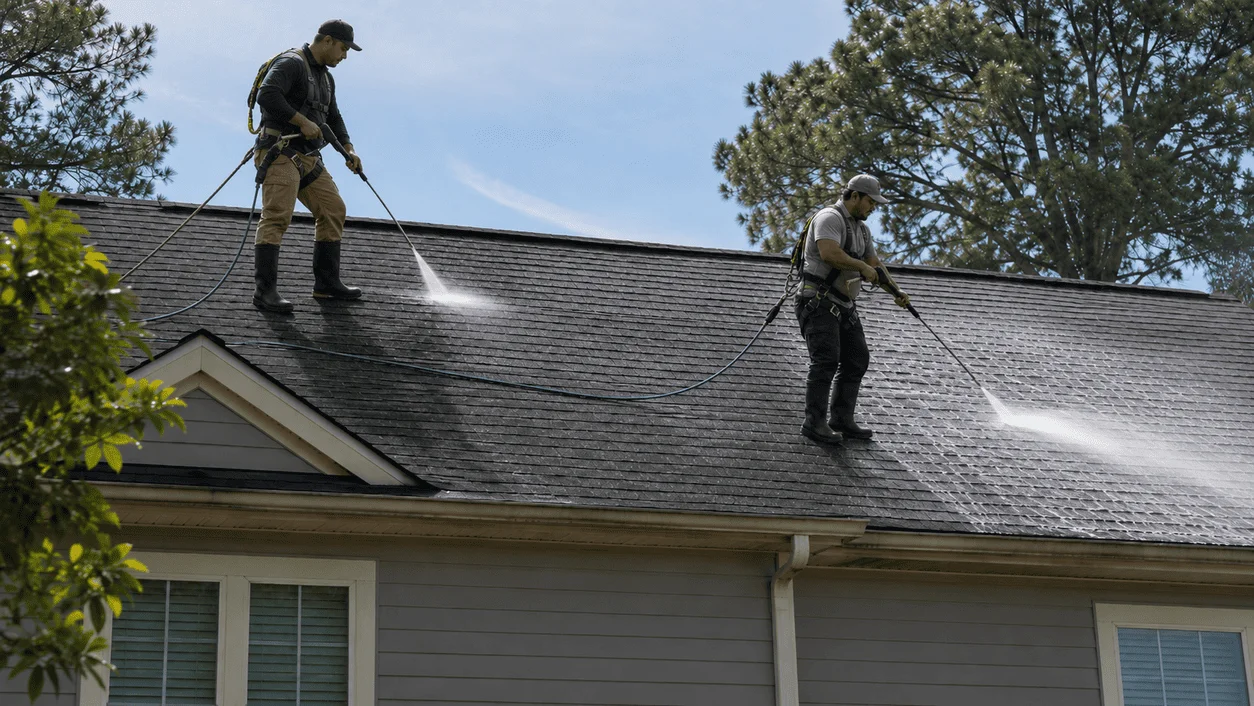
Usually not. Most Long Island roofs are treated from ladders and the ground using low-pressure applicators that reach the surface without anyone standing on it. Less foot traffic on shingles is always better, so we stay off wherever the pitch and layout allow.
Yes, when the prep is done properly. We saturate every plant, bed and lawn edge under the roofline before we start, then rinse everything again when we finish. That pre-wet step is what makes it safe, and it is the step careless operators skip.
No. Rain is what spreads it. Water carries spores down the slope, which is exactly why the staining runs in vertical streaks rather than sitting in patches. Waiting doesn’t clean the roof. It feeds the colony and extends it further down.
It depends on roof size, pitch, how many stories, and how established the growth is. A one-story ranch and a steep two-story colonial are genuinely different jobs. We quote after looking at the actual roof, free of charge, and we will tell you if it can wait another season.
You don’t need a sales visit. Send us a photo of the worst slope and we will tell you whether it is algae, moss or lichen, roughly how established it is, and whether it genuinely needs doing this year or can wait. If it can wait, we will say so.
Popeye’s Power Washing is licensed, insured, and based in Plainview. We clean roofs across Nassau and Suffolk the way the manufacturers say to clean them.