Your home deserves a fresh start!
PVC & Wood Fences Pressure Washing in Long Island, NY
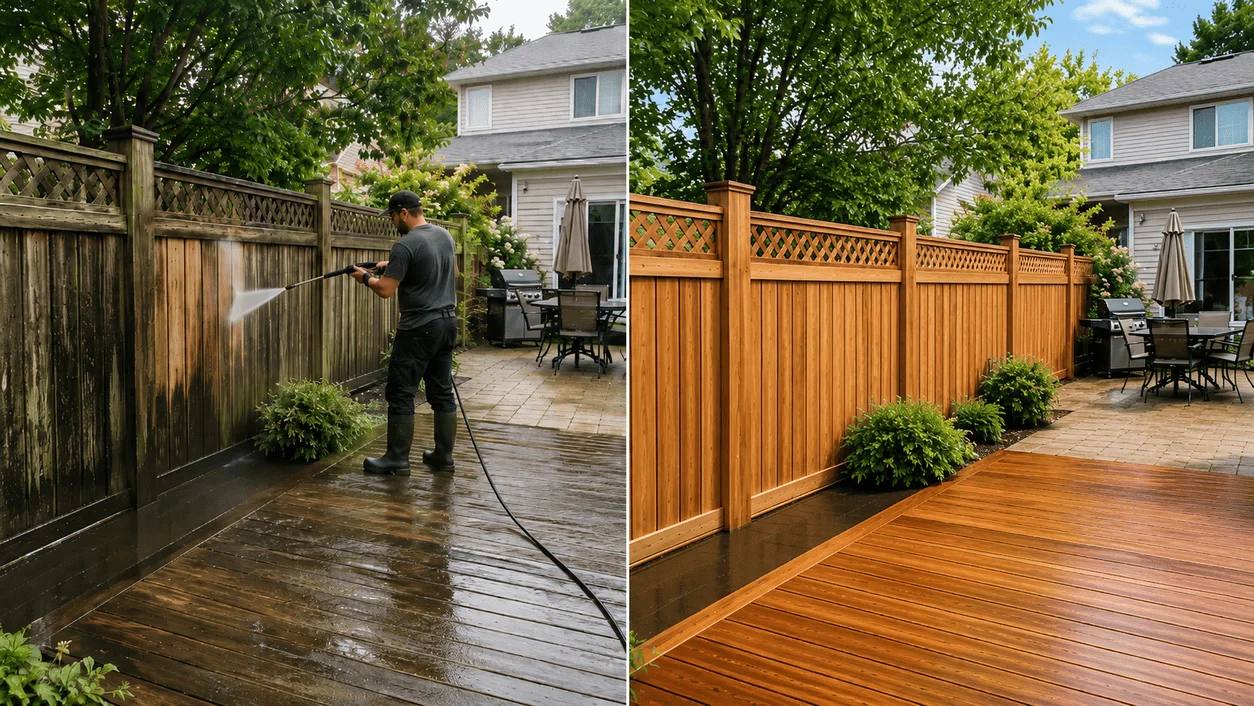
Your fence is the longest surface on your property, often several hundred feet of it, and it turns green faster than anything else you own. Popeye’s Surface Solutions gets white vinyl white again and brings gray wood back to life, with soft washing matched to the material and rust treatment for the sprinkler stains along the bottom rail.
Can You Get A White PVC Fence White Again?
Yes, and it is one of the most satisfying before-and-afters in this business. The green film and black spotting on white vinyl is algae and mildew living on the surface, not a stain soaked into the material. A soft-wash solution dissolves the growth at the root and the fence rinses back to the white you paid for. What vinyl does not tolerate is high pressure, which can crack brittle panels and blow slats out of their rails, so the fix is chemistry and patience, not force. Most Long Island fences need this every 1 to 2 years.
Two Materials, Two Methods
PVC Is Chemistry. Wood Is Craft.
The two fences on Long Island’s property lines fail differently and get cleaned differently. We bring the right process to each.
PVC & Vinyl Fences
Solution dwells on the panels, dissolves algae and mildew, and rinses at low pressure. Post caps, rails, and the textured faces that trap growth all come back to uniform white.
Watch-outs we handle: brittle older panels, loose slats, sprinkler rust at the bottom rail, and green shade lines under trees.
Wood Fences
Stockade, board-on-board, and picket runs get wood-safe cleaner, a gentle rinse with the grain, and an oxalic brightener that lifts the gray and restores the tone.
Watch-outs we handle: furring from past aggressive washes, popped fasteners flagged as we go, and sealing after the 48 to 72 hour dry-down.
Why Fences Go First
The Dirtiest Surface In The Yard
Fences turn green years before siding does, and it is not bad luck. Four things gang up on them.
No Roof Overhang
Your siding shelters under eaves and gutters. A fence stands in every rainfall, dew cycle, and snow melt with zero protection, so it simply stays wet longer.
Ground Splash
Rain bounces soil, mulch, and organic matter onto the bottom two feet of every panel, which is why the green always starts low and climbs.
Sprinkler Hits
Irrigation heads soak the same sections every morning and Long Island’s iron-rich water paints orange rust lines along the rails while feeding the algae.
Shade Lines
Fence runs trace property lines, and property lines are where the trees are. Shaded sections never fully dry, and that is where the black mildew spots bloom.
The Property Line Effect
Hundreds Of Feet Of First Impression
A typical Long Island yard carries 150 to 300 linear feet of fencing, which makes the fence the largest single surface most homeowners own. When it is green, the whole backyard reads neglected no matter how good the lawn looks. When it is white, or warm clean wood, the yard looks maintained from every window of the house and every seat on the patio.
It matters at the property line too. A clean fence is the good-neighbor version of curb appeal, and if you are listing the house, it frames every backyard photo in the listing. We clean both faces wherever there is access, because a fence is only clean if it is clean from both yards.
Included Every Time
What A Fence Wash Covers
- Every panel, both faces wherever access allows, with the solution dwell time matched to how much growth each run carries.
- Gates, hinges, and latches. The most-touched, most-seen part of the fence gets detailed, not just rinsed in passing.
- Post caps and lattice toppers. The decorative pieces collect grime in their crevices and read dirty from a distance.
- Rust and sprinkler stain treatment along the bottom rails, where iron-rich irrigation water leaves its orange signature.
- Landscape protection. Beds and lawn along the run are pre-wet and rinsed, so the garden that borders the fence comes through untouched.
“Our white vinyl fence had turned green on the shady side and orange at the bottom from the sprinklers. It honestly looks brand new, both sides, and they didn’t touch a single plant in the beds.”
Answers
Fence Washing FAQs
Can you get a white PVC fence white again?
Yes. The green and black on white vinyl is algae and mildew living on the surface, not a stain in the material. A soft-wash solution dissolves the growth and the fence rinses back to white. It is one of the most dramatic transformations in pressure washing.
Will pressure washing damage a vinyl fence?
High pressure can. It can crack brittle older panels, blow slats out of their rails, and force water into post caps. We soft wash vinyl instead: the cleaning solution does the work and a gentle rinse finishes it.
Do you clean both sides of the fence?
Yes, wherever there is access. A fence reads clean only if both faces are clean, and the shaded neighbor side usually carries the most growth. If a section backs onto a neighbor’s yard we coordinate access with you before the visit.
Can you remove sprinkler rust stains from a fence?
Usually yes. The orange staining along the bottom rail is iron from irrigation water and it ignores regular washing. We treat it with a dedicated rust remover as part of the fence wash.
How often should a Long Island fence be washed?
Every 1 to 2 years keeps vinyl white and wood healthy. Fence runs along tree lines or on the shaded north side of the yard grow algae faster and sit at the yearly end of that range.
Can a gray wood fence be brought back?
Yes. Gray is UV-killed surface fiber, not rot. A wood-safe cleaning followed by an oxalic brightener restores the tone, and sealing afterward holds it for years. The same process we use on wood decks works on fencing.
Should a wood fence be sealed after washing?
If you want the color to last, yes. Unsealed wood starts graying again within a season. After 48 to 72 dry hours the fence is ready for stain or sealer, and our sealing service can handle that step in the same project.
Will washing hurt my plants and lawn along the fence line?
No. We pre-wet and rinse the beds and grass along the run, and our cleaning solutions are applied at landscaping-safe strengths. Gardens along the fence line come through fine.
Do you clean gates, post caps, and lattice too?
Yes. Gates, hinges and latch areas, decorative post caps, lattice toppers, and arbor sections are all part of a fence wash. Details are where a clean fence actually shows.
How much does fence washing cost on Long Island?
Fences are priced mainly by linear footage, height, and how much growth or rust treatment is needed. Every estimate is free and no-obligation, and adding the fence to a house or deck wash is the most cost-effective way to book. Call (631) 620-2499.
Where We Work
Fence Washing Across Long Island
Based in Holbrook and serving homeowners throughout Suffolk & Nassau:
White Fences White. Wood Fences Wood.
Fall Special: 20% Off When You Call – Offer Expires 11/30/26
Free, no-obligation estimate. Open Mon-Sun, 10am-7pm.
Call Now & Save 20% (631) 620-2499